U.S. Rep. Eric Sorensen has a message about what Democrats should run on this November — groceries, gas prices, and the doctor's bill.
"It is not about any social issue," the Democrat told a few hundred constituents packed Thursday evening into the Gateway Building on the Peoria riverfront.
"It's got to be about who's going to lower our grocery prices, who's going to lower the gas price, who wants to make sure that I have health care," Sorensen said.
That argument was the through line of a town hall that ran nearly two hours, and it came paired with a self-critique of his own party.
"Everybody knows you guys hate Donald Trump," he said about Democrats. "Nobody knows what you're for."
The town hall was part listening session and part campaign argument. Sorensen is a second-term Democrat representing what he described as a "D plus two" district, meaning a razor-thin Democratic lean in a swath of Illinois that runs from Peoria to Rockford and includes parts of Bloomington-Normal.
Retail politics
That kind of retail politics, he argued, is what cuts through in a purple district. "I'm not going to argue stupid politics," he said. "Instead I'm going to do what I can to lower your cost."
On fuel costs, Sorensen said he's been pushing for year-round sales of E15, a gasoline blend with a higher ethanol content. Currently, federal rules limit when E15 can be sold.
On prescription drugs, he described a bill he's leading called the Stop Games Act. “Big Pharma,” he said, has been gaming the FDA's generic drug approval process to protect name-brand sales.
"They want to sell their $300 pill and not the $3 pill," he said. "My Stop Games Act would make it illegal for them to meddle in it — to make sure that we can get these generics to market."
On infrastructure, Sorensen said he's been fighting to redirect federal lead pipe replacement funding to Illinois, saying that the 17th Congressional District has more lead service lines running to homes than any other congressional district in the country.
He said the state of Florida currently receives more of that funding despite having some of the newest water infrastructure in the country. “Why is the funding going to Florida when the funding is needed in Illinois?” he asked.
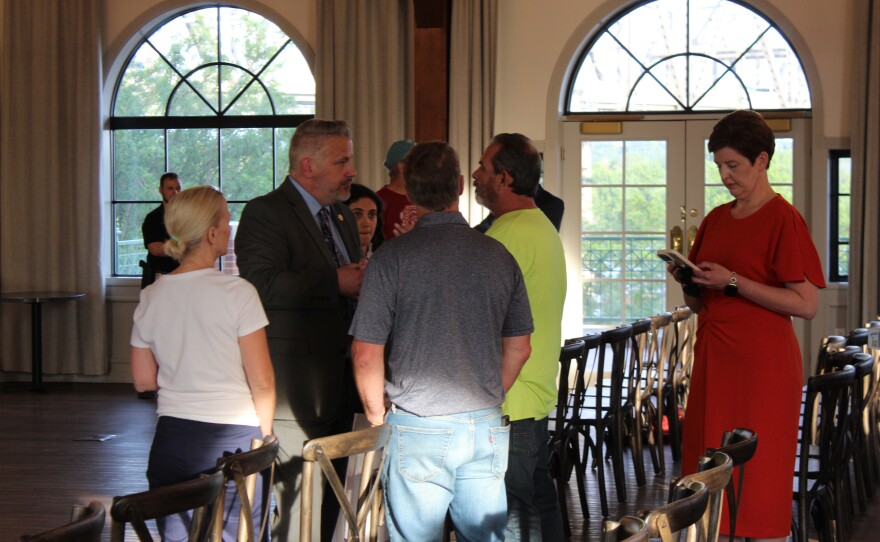

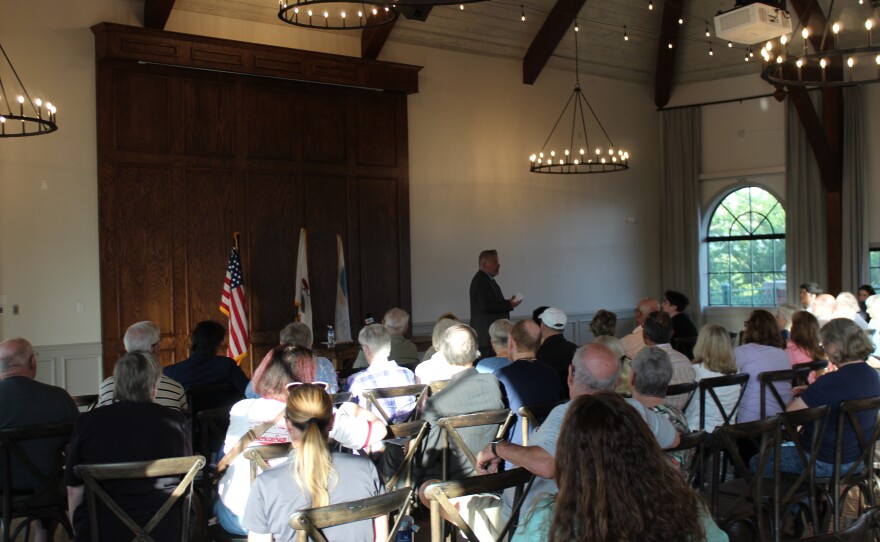
Questions from the crowd came in on note cards, collected by staff and read aloud by Sorensen at random.
Midterm election
One asked whether Democrats were doing enough to protect the midterm election from interference. Sorensen said the question cuts to something that keeps him up at night. His concern isn't a mass deployment of federal agents on Election Day, it's something more targeted. He said the administration could identify precincts with large concentrations of immigrant families and station ICE agents outside.
"If you go to the polling place and you put them out front, how many families are going to drive up and go, 'Oh my god, no, my family's more important,' and turn around and leave."
Laws against that kind of intimidation already exist, he said, but he's skeptical they'd be enforced.
On voter participation, he asked the room how many people would be willing to drive a neighbor to the polls. Most hands went up. Do it five times on Election Day, he said.
Another question asked about Pentagon financial accountability, specifically why Congress couldn't compel the Defense Department to answer budget questions. Sorensen said his response was to get himself a seat at the table.
After winning reelection, he went to House Minority Leader Hakeem Jeffries and asked to be placed on the House Armed Services Committee.
That positioning meant that when Defense Secretary Pete Hegseth appeared before the committee, Sorensen said, "I can ask him the tough question," adding he used that leverage this year to secure $33 million for the Rock Island Arsenal.
A question about transgender protections drew a more personal response. Sorensen, who attended Catholic school for 12 years and described having conservative parents, said the issue is close to him. "Everyone in this country, no matter who you are, has the right to liberty and the pursuit of happiness," he said. "Nobody should be able to take that away."
On rural health care, Sorensen described a hospital in Macomb that nearly closed after Medicaid cuts — the facility was roughly half Medicaid-dependent. It survived by opening its own pharmacy. Sorensen blamed Republican officials for voting for the Big Beautiful Bill that slashed Medicaid spending.
He acknowledged, with some weariness, that his second term has been harder than his first. He pulled out his congressional voting card — the physical card he inserts into a machine to cast a yes or no vote.
"The hardest part of my job," he said, "is putting this card into the machine and deciding which button to push. Because it's not me voting. It's 740,000 people who are voting."
He closed by noting that his parents met in Peoria, got married there, and then moved to Rockford, where he was born.
"This is worth fighting for," he said.