


A group of 11 Illinois State University students, a staff member and myself started off the new year by volunteering for 10 days in Río Cuarto, Alajuela.
The rural province in Costa Rica is just over a two-hour drive north of the country’s capital, San José, and offers a slower pace of life than what many of the students were accustomed to back home.
ISU students have been participating in alternative break trips since 2000 and have been traveling to Costa Rica for nearly a decade through the organization Cultural Connections and Volunteers.

These trips are designed to immerse students in service-based learning experiences that challenge their perspectives while encouraging civic responsibility beyond the classroom.
Former ISU Alternative Breaks coordinator Kelly Hasselbring said the focus of these trips is to increase students’ civic engagement, which is a core value of the university, and to help students step outside their comfort zones.
"I think it's sometimes hard to put yourself in an uncomfortable situation, but that's where you grow, is being uncomfortable," Hasselbring said. "So I think that can cause some difficulties, but more often than not, at the end, they're like, 'Oh my gosh, I'm so glad I did this.'"
Being in extremely close quarters with a dozen strangers for over a week was a new situation for many of us on the trip. There were four or five of us sharing bedrooms with bug netting over each bed, and only two bathrooms in the house.
“Every ISU student should do an alternative break, I think,” Hasselbring said. “Anyone trying to meet new people, anyone interested in traveling and helping others, learning more about social issues and our country and the world.”
Service
On the Costa Rica trip, the 11 ISU students, one other staff member and I stayed on a host family’s farm belonging to Edgar and Lorena Sánchez.
Each day, Lorena cooked three warm meals for Edgar and all 13 volunteers, usually consisting of rice, beans and meat. The shared meals became a routine, reinforcing the sense of community found throughout the trip.
After breakfast, we would head out either to Edgar’s vast pineapple fields or to a scrap-metal house we were building for two young Nicaraguan immigrant families.
Most students favored working on the house over the prickly pineapple fields in the hot Central American sun, plus the construction work allowed them to see tangible progress each day.

ISU junior Me’Kyla Davis said her favorite part was mixing the cement herself, which was used to build a stove and staircase for the Nicaraguans’ house.
“Back in the US, we actually have the cement and then pour it. Out here, we made the cement from scratch,” Davis said.
Through a Spanish-English communication barrier, the other volunteers and I were able to figure out exactly how many scoops of rocks, powder and water Edgar needed each time we mixed the cement.
“It never came to my mind that you had to build cement from scratch,” Davis said.
For the house we were building in rural Costa Rica, everything was done from scratch.


The walls were made out of scrap metal and wood, the stairs were crafted from old tires filled with dirt and homemade cement, and the stove was built with cement and cinderblocks.
ISU junior Arete Smith said the skill she’s taking back home after this trip is learning how to improvise.

“Think outside the box for everything, no matter what it is,” Smith said.
That mindset became especially important when navigating the language barrier.
The students, staff member and I became experts at charades by the end of the trip and, through context clues, could figure out whether Edgar was asking for a hammer or telling us it was time for lunch.
Despite the language barrier and our group consisting of 13 amateur construction workers, we finished building and painting an entire house, complete with two beds and a stove.
The two immigrant families now living in the home have access to shelter, running water and a way to cook food–resources that will help give them stability and a fresh start in a new country.
Going through this experience was “eye opening” for ISU senior Diego Mendoza.

“The people in Costa Rica, unfortunately, don't have as many resources as we do,” Mendoza said. “They may not have clean shoes, they may not even have toothpaste, they may have to sleep outside. While in America, we have strong access to electricity. We always have Uber or Lyfts. We always find a place to go.”
Mendoza said the trip helped him uncover a part of himself that he always knew existed, but needed an experience like this to fully understand.

“What I want to bring back [home] most is just a stronger work ethic,” Mendoza said.
The immigrant families told our group that they were grateful for how much hard work we put into their new home, which was a moment that highlighted the real-world impact of the students’ labor.

The pineapple fields
On days we were not constructing the house, we hiked out to Edgar’s pineapple fields to pick, sort and eventually package the pineapples for distribution.


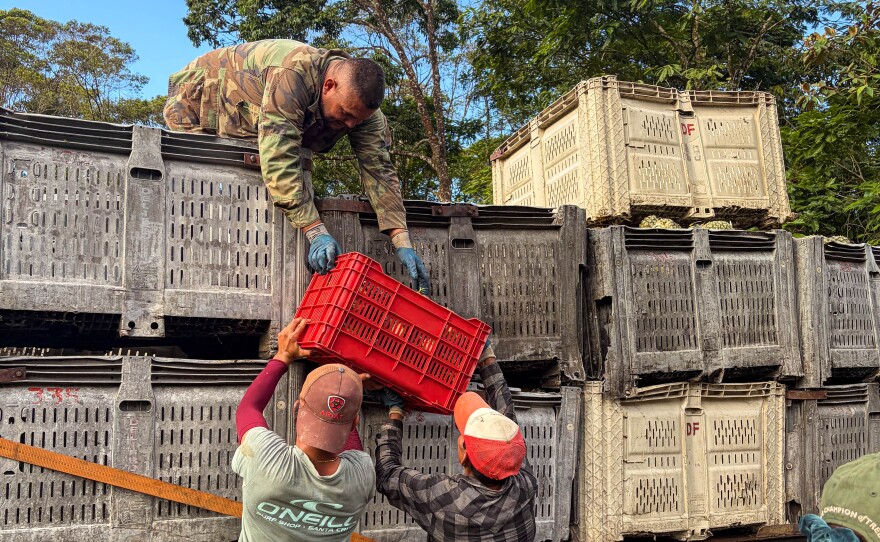


This part of the service was the most physically challenging for a majority of the group, including myself, pushing students beyond their comfort zones both mentally and physically.
Pineapples have to be handpicked from the base of the plant, which is close to the ground, and surrounded by razor-sharp leaves under the blazing sun.
“It was poking you, and it was hot, and we couldn't wear shorts, we had to wear long sleeves,” Davis said. “That was very challenging because I wanted to give up so bad, I wanted to leave, but it was more so a mental thing. So I'm telling myself, ‘I have to push through, I can't leave.’”
Despite the humid heat and painful pineapple scratches, the volunteers and I picked two entire fields of pineapples, yielding about 10,000 fruits.
Later in the week, we were up at the crack of dawn to load the thousands of pineapples into a truck with the help of Edgar’s employees.
No one in our group of volunteers had ever loaded a pineapple truck before, so we struggled at first to find an efficient workflow.
ISU senior Sophie Shaw said the most challenging part was learning how everybody worked together.

“Once we were able to kind of figure out everyone's strengths and just do everything based off that, and then also asking Edgar how he thinks we should be, that [was] very helpful,” Shaw said.
Learning opportunity
A culture shock that every volunteer noticed was the slower-paced lifestyle in Costa Rica.
“[In the US] you're constantly just expected to be moving. So it was really nice to just come here, and you can still work hard and still get a lot done while taking things at a slower pace,” Shaw said.
The slower pace is part of the “pura vida” culture, which directly translates to “pure life” but holds a deeper cultural meaning.
“Pura vida” was used in nearly every context in Costa Rica. Servers said it as a way to say “you’re welcome,” and shopkeepers used it to say “goodbye.”
More broadly, it is a philosophy of life that emphasizes simplicity, gratitude and living in the present moment. Many of the students said they hope to carry these values with them after returning home.
One of the student leaders on the trip was senior Dru Thigpen. She said anyone going on this trip has to be open-minded.

“It's quite different from what most of us are used to back home,” Thigpen said. “It's such a slow pace here, so just being patient and going with the flow is important.”
This trip has been a significant learning opportunity for Thigpen, who participated in the Costa Rica alternative break last year and returned this year as a leader.
“It's been totally different just figuring out logistics, trying to make sure everybody is okay, everybody is happy, and making sure that we're all working together hard,” Thigpen said. “I've never been in a leadership role like this, so just problem solving has been a little bit hard for me, but I definitely feel like I'm learning a lot about myself as a leader and just about everybody else around me.”
Former Alternative Breaks coordinator Hasselbring said anyone at ISU looking to gain leadership experience should consider participating in an Alternative Break trip.
“A lot of students will change their trajectory after they go on an AB trip,” Hasselbring said. “They'll be like, ‘Well, actually, after graduation, I want to be in the Peace Corps. I've had multiple students that ended up doing that, which is amazing, or AmeriCorps.’”
Hasselbring cautioned that the social issues students encounter on these trips can feel heavy, but nightly reflections provide a safe space to process those experiences together.
Davis said volunteering in Costa Rica has made her more grateful.
“I feel like I've always been a humble person, but being in this setting, seeing the stuff, for example, we don't have mops out here, we have broomsticks with rags on them,” Davis said. “So that just showed me, if there's a will, there's a way.”
Future of Alternative Breaks
Alternative break trips have made significant impacts on ISU students for over two decades, and the program has become more expensive for the students in recent years.
"I wish that our budget wasn't cut," Hasselbring said. "I had to raise the fees, and that makes it less accessible to all of our students, and that is extremely disappointing to me, because the trips were so inexpensive previously."
Hasselbring said she has seen less applications come in for trips, especially the domestic spring break trips.
"I mean, it's still way more affordable than if [the students] were to try to do all of this on their own," Hasselbring said. "We try to make it as inexpensive as possible. That's why we stay with host families and all of those things."
Students in any major at ISU can apply for the trips, including graduate students.
Applications are currently open for the alternative spring break trip to Tennessee, where the group will be cleaning up trash in rivers and lakes.
