

Bloomington-Normal area high school and college students sought solutions to nationwide food waste issues during a hackathon event at the State Farm Hall of Business. They used Artificial Intelligence to do it.
The AI Community Innovation Workshop brought together 30 students from 10 majors and four different colleges for an opportunity to learn how to more ethically and responsibly use AI tools. Students were then judged on presentations of the solutions that their groups came up with, based on feasibility and clarity.
Is using AI contradictory?
AI technology continues to see resistance from people who say the environmental impact of the massive data centers that fuel it is too great. A 2024 report from the Lawrence Berkeley National Laboratory projected that data centers could consume up to 12% of electricity in the U.S.
Many Bloomington residents told the city council Monday that they opposed a data center being built in southeast Bloomington.
“[A data center] does nothing good for our community. It provides fewer than 200 permanent jobs,” said Sarah Adelman. “The water use, the pollution, the energy costs we are already — people already cannot afford their energy bills.”
But the feeling for some at the hackathon was that AI is not going away anytime soon. That means it may still be worthwhile to use AI to solve environmental issues when being selective about when to use it.
“We know some immediate impacts as it relates to water and energy use and the power grid and things like that,” said Christine Bruckner, assistant director of the Illinois State University Office of Sustainability. “If we can teach our students to use it responsibly and ethically, and conserving energy in the ways in which they're using it, it's a great opportunity.”
Julie Hinman is a teacher in the art department at Unit 5 Schools. She and several students in her innovative entrepreneurs class came to participate in the hackathon. She said AI is best used for specific, not excessive purposes.
“You don't want to do everything for you, right? What you want is to find those things [where the information] would take weeks or months to come up with,” said Hinman. “Especially when you're looking for data on food waste and across the globe those types of things.”
Tough-to-digest food issues
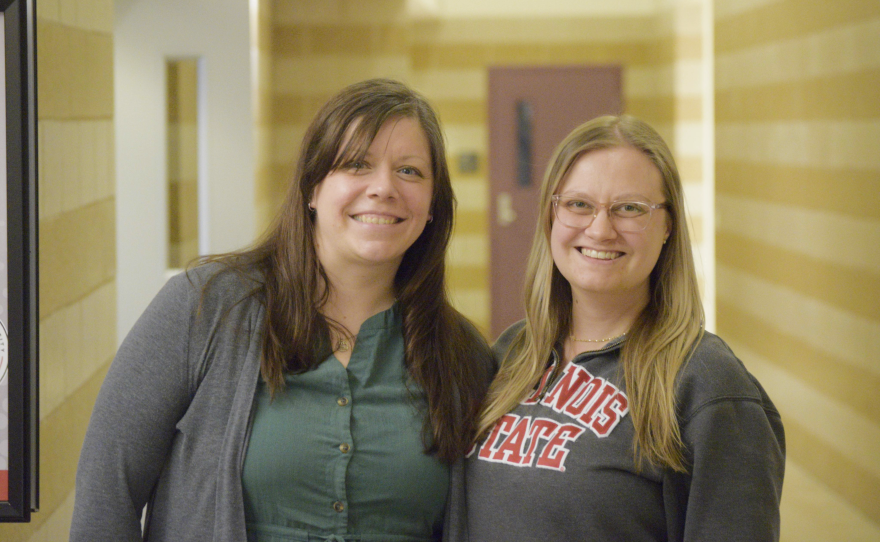
Representatives from the Office of Sustainability and Center for Civic Engagement [CCE] provided an overview for the national issue of food waste that students were tasked with helping to combat. A representative from the School Street Food Pantry also provided a local perspective.
“Anywhere from 30 to 40% of our food supply is being wasted,” said Bruckner. “So we're really looking at a high volume of wasted food which impacts not only our landfill capacity, but also has us thinking about our processing of food and where we're losing food along the way in that process as well.”
The CCE often partners with the Office of Sustainability for community-relevant issues.
“We are really excited... to really innovate solutions that are student-centered and interdisciplinary to this issue that is very relevant, both at Illinois State University, where we have a lot of students that are food insecure, and in Illinois broadly, where we have such a high rate of food insecurity,” said Rachel Waring-Sparks, assistant director of assessment at the CCE.
Event format
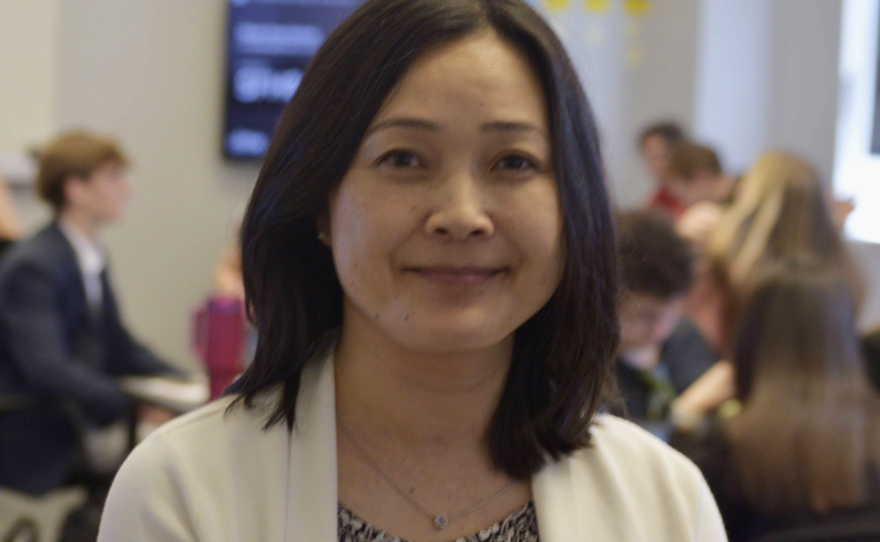
Chiharu Ishida, a professor in the ISU Department of Marketing, provided a 45-minute lecture on what students needed to know about how to properly use AI before they began.
“AI is like a good brainstorming partner. It can give you access to a lot of information and also a good knowledge base,” said Ishida. “So it's a good partner but a partner is only as good as instruction you give.”
Because of this, Ishida told students it takes someone with knowledge of the subject matter to make a productive prototype that can combat food waste.
“It can only perform within the parameters that you set. So in that sense... you have to be creative yourself. And you have to offer your expertise and kind of guide AI through this process as well.”
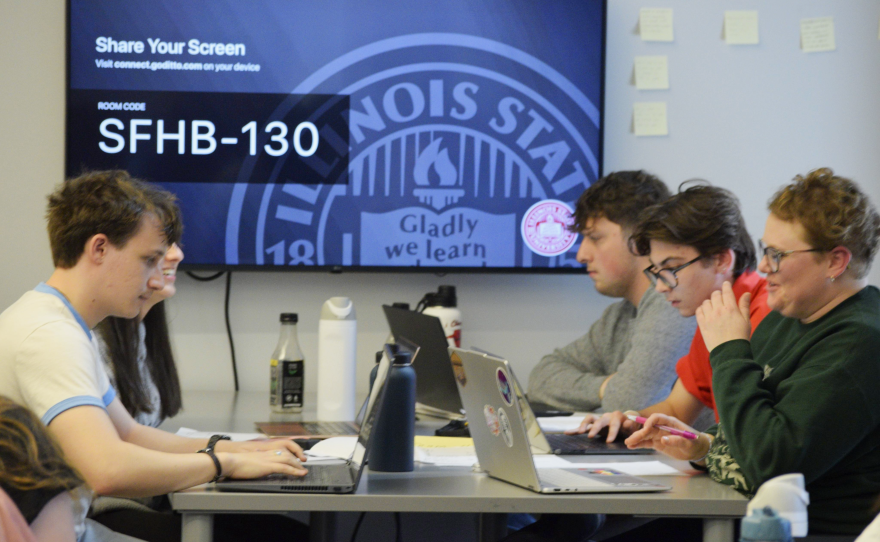
After a morning of talks from experts and community partners, students got to work in the afternoon. They broke off into groups. Because of the wide array of majors and interests, each group had a good mix of expertise to lend to a final project.
“I think that's just a great learning environment overall, getting to work with different types of majors and backgrounds,” said Luke Read, senior marketing major at ISU. “I get to learn from them, be collaborative with them, and it's only going to help me in the future, working with different collaborative environments.”
Read’s group worked on an app that could help with grocery shopping. While putting items in the cart, it could scan items for shoppers and come up with different recipes and ideas for meal planning and waste prevention.
“So if they use one recipe with a green pepper, but they only use half of how many green peppers they have, it gives them options to utilize the rest of that so they don’t just throw it in the trash,” said Read.
As a marketing major, the plan was more heavily technology-based than most things he is used to.
“But I'm slowly starting to learn and get educated on how I can represent that to people,” said Read. “Because that's my job as a marketer, to take a very big concept and then digest into something very understandable. So I get to flex that muscle a little bit.”
