

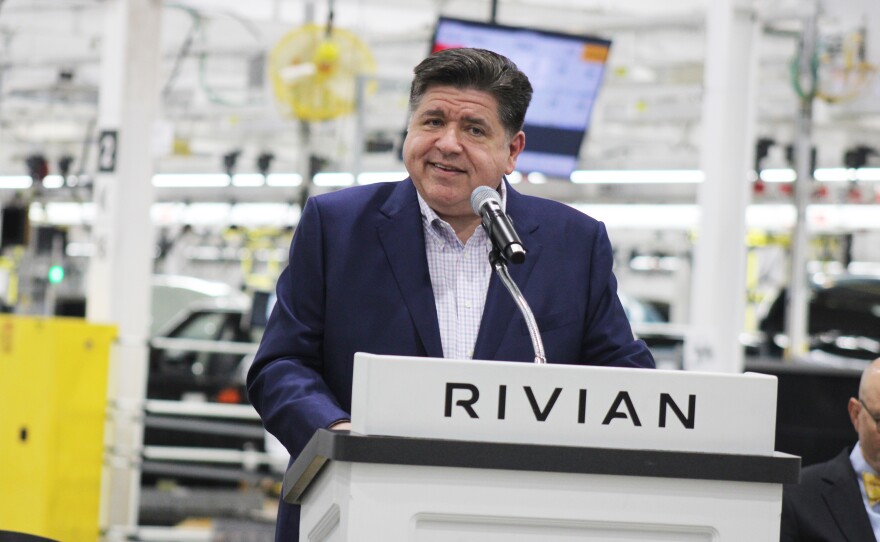
Gov. JB Pritzker visited Rivian’s new manufacturing plant in Normal on Tuesday and suggested that the company’s new R2 model could open up the market for EVs to middle-income buyers in the same way that Ford’s Model T did for regular cars a century ago.
Speaking steps away from the R2 production line, Pritzker noted the Model T helped cars evolve from a luxury to an accessible option in the early 20th century, ultimately transforming the middle class. He noted the R2's lower price point – starting at $45,000, much lower than Rivian’s R1 launch vehicles that started at $72,990.
“It’s a product for the middle class,” Pritzker told a crowd of elected officials and Rivian workers. “It’s a product for people who haven’t otherwise been able to afford an electric vehicle in the U.S., and I’m proud it’s being made right here in Normal and in Illinois.”
Rivian founder and CEO RJ Scaringe showed Pritzker around the inside of an R2 during Tuesday's visit. Pritzker said he’s placed a preorder for a R2 for himself, and he already has a R1 model that he said he uses on a farm. “It works beautifully and we love it. I can’t wait for my more in-town vehicle that’ll be the R2,” he added.
R2’s launch is high stakes for Rivian, which has faced major headwinds on its journey to becoming McLean County’s second-largest employer, including COVID, supply-chain disruptions, trade disputes and now a Trump administration that is openly hostile to EVs.
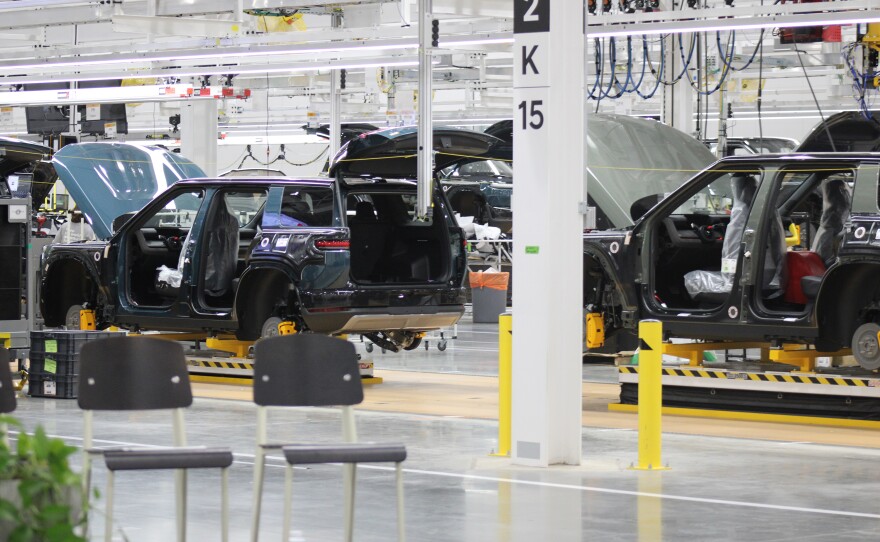
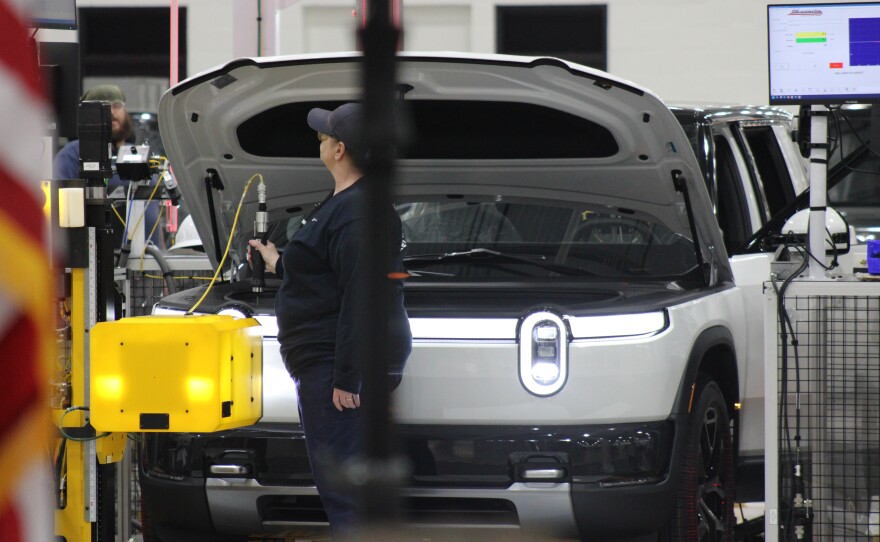
The first R2s came off the line in Normal last month. Rivian invested $1.5 billion on a major expansion in Normal to accommodate R2 production. In exchange, Rivian is set to receive $827 million in state tax breaks and other incentives over the next 30 years. Rivian was also awarded $16 million in state incentives plus more local tax breaks to build a new supplier park just west of the main plant, across Rivian Motorway.
“And with Rivian’s new supplier park, a whole new EV ecosystem is being created right here in the Bloomington-Normal area,” Pritzker said.



Workers and training
Rivian will no longer say how many people it employs in Normal, despite the combination of local and state incentives it’s received. Clues suggest headcount is somewhere between 5,000 and 7,000. More hiring is expected as R2 work adds a second shift by the end of 2026.
When asked about Rivian’s unwillingness to share how many people work in Normal, Pritzker said the company is obligated to share certain jobs data with state economic development officials on a “somewhat regular basis,” though they have not yet been required to do so.
“As to revealing how many people … it’s whatever they’re required to do. They’re a private company. They don’t have to send you or me or anybody a number, except of course to meet the requirements of the incentives. And that’s at DCEO [the Department of Commerce and Economic Opportunity]. And they haven’t been required yet to do that,” Pritzker told reporters.
However many people work there, training is required. Partly to meet Rivian’s training needs, the state helped fund a $17 million advanced manufacturing facility, including an EV lab, at Heartland Community College in Normal. Rivian will soon get a second advanced manufacturing training facility on-site in Normal that will “align seamlessly with the one at Heartland,” said Lisa Clemmons-Stott, chief business attraction and development officer at DCEO.
Also speaking at Tuesday’s event was Megan Brown, who works in facilities operations at Rivian. She’s lived in Central Illinois for around 15 years and remembers hearing that a little-known company called Rivian was considering a move into the former Mitsubishi plant a decade ago.
“We were excited but were a little nervous. What was this company? Were they for real?” Brown said. “Of course, what you see today quickly puts those doubts to rest.”
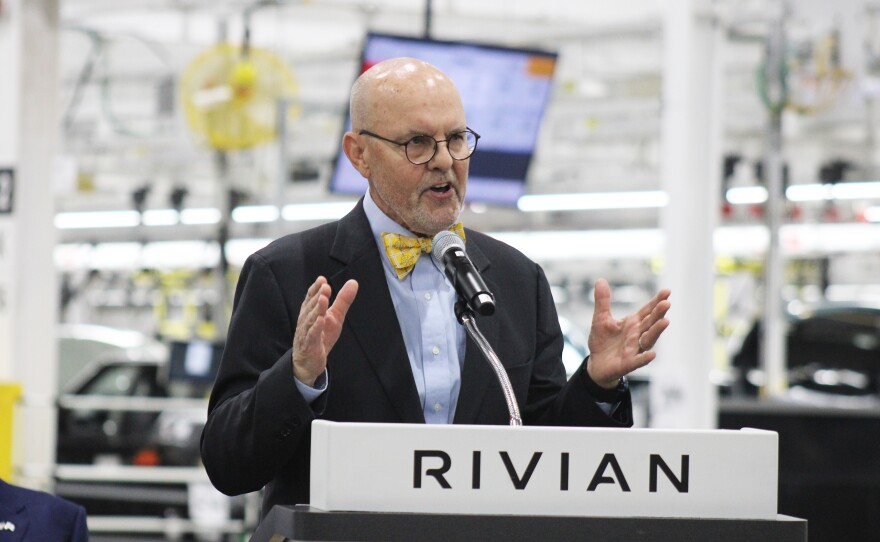
Joining in Tuesday’s victory lap was Normal Mayor Chris Koos, who led the town council that ultimately approved the first tax breaks that helped lure Rivian to town. He said Rivian’s growth since then has exceeded “everybody’s expectations.”
“What’s good for Rivian is good for Normal. And what’s good for Normal is good for Rivian,” Koos said.
