


Unit 5 families have two draft options to submit feedback related to the districtwide enrollment survey.
Families can review the two proposals and complete a survey until March 1. Survey responses will be used by the team at Cropper GIS, the consulting firm working with Unit 5, to help shape final recommendations presented to the Unit 5 school board next month.
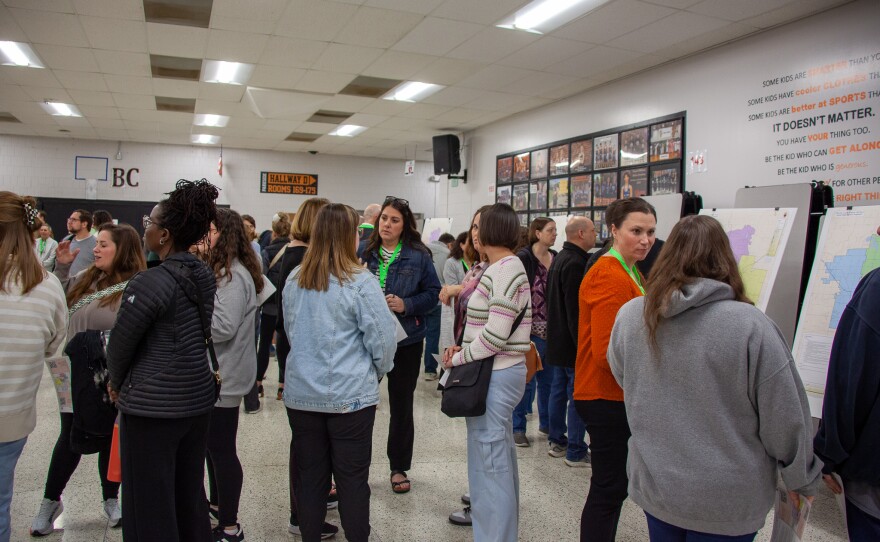
Cropper presented the draft options Thursday at Parkside Junior High School.
Option 1
The first proposal calls for closing Carlock Elementary School, repurposing Glenn Elementary to serve the 18-22 transitional services program currently at Eugene Field, changing boundaries to increase enrollment capacity at Sugar Creek and adding to Parkside Junior High to enroll students from Pepper Ridge.
Closing Carlock would result in students from an area predominantly north of Interstate 74 being sent to Hudson Elementary School, with others being sent to Fox Creek.
Glenn Elementary taking on the transitional services program currently at Eugene Field would put students in a more accessible environment, according to the proposal. Students in the program receive individualized education services until the age of 22, allowing them to build independent living skills and continue to find educational opportunities.
A former three-story elementary school, Eugene Field, is not accessible for people with disabilities and would close under the proposal. While there is a main work area on the first floor, the building does not have an elevator. Installing one would require asbestos abatement.
“There’s just lots of challenges with the building,” said Unit 5 Superintendent Kristen Weikle. “It just doesn’t make sense, we think, for our 18-to 22-year-olds.”
Under Option 1, at Sugar Creek, students in the northeast corner of its current zone would be switched to Grove Elementary because of their close proximity to that school. This moves about half a dozen students out of Sugar Creek.
Sugar Creek also would absorb the students displaced by the Glenn Elementary change.
Sugar Creek and Brigham are the two schools in Unit 5 with early learning — both enrollment proposals would close Brigham and combine both schools’ youngest students into a new early learning center.
“We think that's what's best for all of our three, 4- and 5-year-olds,” said Weikle. “We think it's best for students, we think it's best for families to have one location.”
Pepper Ridge Elementary School students would be sent to Parkside Junior High, rather than Evans. This also would include a portion of Cedar Ridge students along its western boundary who, in both proposals, would be sent to Pepper Ridge to ease enrollment.
A recommended addition to Parkside would create additional capacity for the school to accommodate the additional students and provide more support for special education programs there.
Option 2
Under Option 2, Carlock Elementary would not close and Fox Creek, Sugar Creek and Kingsley Junior High would all see changes.
To avoid closing Carlock, the Traditions neighborhood becomes an open attendance area that would net the school about 50 students. That neighborhood is near the Bloomington Walmart, and just south of Marcus Theatres. It is about 15 minutes from Carlock Elementary.
With an enrollment of about 100, Matthew Cropper, president of Cropper GIS, said Carlock needs about 50 more students to be sustainable in the future.
Previously, The Traditions neighborhood was zoned to Fox Creek Elementary. That school would gain students north of Six Points Road, who were previously at Pepper Ridge. It also may keep some students from the Traditions neighborhood.
Sugar Creek would become a K-5 school, and see its northeastern corner moved to Grove — as it would in Option 1. In Option 2, these changes would be used to open up space for specialized service classrooms and spaces, something not done in Option 1.
Instead of Parkside, Pepper Ridge would feed into Kingsley Junior High in Option 2, providing relief to Evans.
Common ideas
There are a few proposed changes that are included in both proposals.
Benjamin Elementary territory north of Empire Street would move to Towanda Elementary, relieving enrollment pressure at Benjamin. This comes with an expansion of Towanda to increase capacity to about 250-300 students. Current enrollment is shy of 200.
In addition to moving some students on the western portion of Cedar Ridge’s boundary to Pepper Ridge, open enrollment would come to homes on Tracy Drive, Oak Creek Plaza, Donnie Drive and Urban Street.
Parkside Elementary territory south of Raab Road and north of Orlando Avenue would become open enrollment to provide more relief there.
Both options provide relief to Evans Junior High School.
At the high school level, the neighborhoods east of Linden Street, north of Pine Street and west of Henry Street would switch to Normal West, easing enrollment issues at Normal Community.

Parents respond
After the hour-long presentation of options from Cropper and Weikle, those attending with questions or input were able to view any of about a dozen copies of possible new mapping layouts. Planning team members at each set of maps were there to explain in further detail, or listen to feedback.
“People have been very pleasant, good questions,” said Scott Peters, principal of Prairieland Elementary. “Just people trying to clarify, like, ‘OK, here's my neighborhood, just to make sure, am I staying? Am I going here?’ Just trying to get a little more information for their own family situation.”
Because questions were mostly geared toward personal situations, Peters said those he spoke to did not generally lean toward either option.
Carlock Elementary
Jillian Nelson, a community organizer with Keep Carlock Elementary Open, spoke with Cropper when his presentation was over. She said Cropper’s presentation neglected to consider the financial ramifications of any proposed changes.

“If you're going to ask a community to give up its entire school,” said Nelson, “you really need to make a case for why that's important, either fiscally for the district, or how it's going to benefit other students in Unit 5. How is it going to make their learning outcomes improved? And no case has been made to really demonstrate that.”
Facility renovations would be paid for through County Facility Sales Tax dollars, rather than any new taxes, said Weikle.
Nelson and other Carlock advocates also still disagree on two points made again at Thursday’s meeting: that a school with fewer than 150 students is unsustainable, and that transportation is a major issue for the school covering the northwest region of Unit 5.
Nelson said there are 140 schools with less than 150 students still operating in Illinois, and the about two-thirds of students bused in to attend Carlock is still not the highest percentage in the district.
“They're presenting some of these facts like they're going to be huge cost savings,” said Nelson. “And if you're not a family in Carlock, you might just assume that to be true.”
Nelson said members of Keep Carlock Elementary Open will now look over the data presented Thursday to further make sense of how changes from each proposal would affect families currently sending their kids to Carlock. Adding students to Carlock to provide relief to other schools, as included in Option 2, has been a goal for Carlock advocates since the school’s closure was first floated in the fall.
Glenn Elementary
The repurposing of Glenn Elementary School in Option 1 is a non-starter to Kevin Bersett, the father of a current and former Glenn student.
Bersett spoke during a previous school board meeting as the only non-Carlock parent to ask for clarification on a rumored repurposing of the school. Unlike Carlock, Glenn Elementary parents have not organized against such a move because it was not explicitly mentioned in meetings until Thursday.

“I think if you're going to close elementary schools, it should be a last resort,” said Bersett. “And obviously it isn't the last resort, they have multiple proposals.”
Glenn Elementary School serves students from an area east of Main Street, with the campus of Illinois State University at its north end and Carle BroMenn at its south end. Further south, past Division Street, is in District 87.
“Glenn is right in the middle of town there, and it's one of the few schools right there that kind of knits the community together, and it brings a lot of parents and families,” said Bersett.
Glenn was designated as Commendable, according to the latest state report card, with no under performing student groups, but without performance that was nonetheless deemed outside of the top 10% of schools statewide.
Spending per student is below the Unit 5 average — 48.5% of students are low income, slightly less than the statewide average, but higher than the Unit 5 average of 37.8%. But only 10.7% of students have IEPs [Individualized Education Programs], while the district average is 19.1%.
While Glenn families did not get a head start on organizing, Bersett said a petition in support of the grade school is making the rounds on Facebook. He said more than 450 have signed it as of Thursday.
Survey effects
For Matthew Cropper, this is not the first time he has taken part in a meeting like this.
“There's a big emotional component to it. Parents are very emotional about their schools, are passionate about their schools, and they're very resistant to change,” said Cropper.
But while the survey responses are an important step toward a final recommendation, he said it's not as simple as just tallying support for Option 1 vs. Option 2.
“The feedback that we're looking for [is] things that are constructive, that can help us make things better,” said Cropper.
There also are still options on how a final recommendation from Cropper GIS might be formed.
The school board could decide between two separate proposals with tweaks coming from survey responses, or the responses could result in a hybrid proposal that merges some ideas from both proposals.
