The College of Engineering at Illinois State University is prepared for its first year in its new home.
The more than 28-acre site at 1709 and 1711 G.E. Road, still occupied by Country Financial at the latter address until the new year, is ready for students to arrive for classes by the start of the 2026 fall semester.
Lay of the land
The two-story building features a mostly lab-focused first floor, with space for mechanical engineering and first year engineering studies. The second floor is where the dean suite, electrical engineering and more classrooms are. Classrooms range from 30- and 50-student rooms for more focused studies, up to 125-student spaces.
There will be ample space for the 2026-27 school year. Only freshman and sophomore students will occupy the building.
“But by the time we get to the junior year, they're going to start to get full,” said Tom Keyser, dean of the engineering college. “And by the time we have four classes of students, scheduling will be tight, but we'll make it work.”
Keyser said the building will suit up to 700 students comfortably, after which he said the college will start talking expansion.
The freshman class, which in the school’s first year occupied Williams Hall, had 168 students.
“That was more than what we really would have expected, and that's without showing our students a building, a classroom, or anything. They just trusted that,” said Salil Bavdekar, assistant professor in the Department of Mechanical Engineering.
The freshman class outnumbered the university’s goal of a 130- to 150-student freshman class when ISU initially began considering the purchase of the Country Financial building in 2024.
“So now, ...we have a lot of cool stuff to show them. All of our labs and classrooms have all this glass that you can look into. You can see the students working on things,” said Bavdekar. “I think it's going to make it even better for the College of Engineering going forward.”

Key locations
The atrium area was largely unchanged from how Country left it.
“It’s a big gathering space, population space, but it's also an event space,” said Matt Aldeman, professor and associate dean.
Keyser said he learned from visiting deans of other engineering colleges about how to be intentional about how to design study spaces. The atrium area became that space.
“There'd be like a nook here, something there, and almost every single one of those, there were no students in it. The students would grab a table and just study wherever they wanted to. So the idea of this space was, ‘Let's leave it as open as we can,’” said Keyser. “The furniture, they can move around if they want, but we have great study spaces or just hangout spaces for students, and they can kind of customize it however they want.”
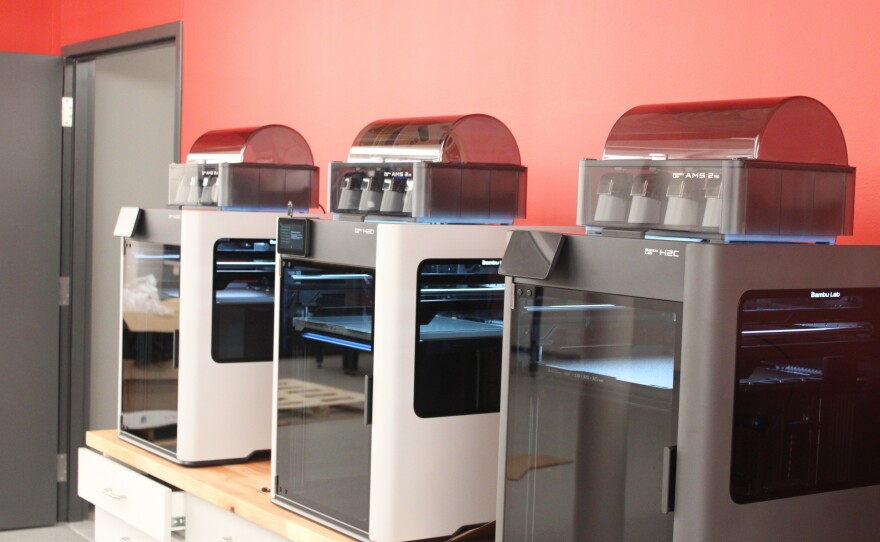
Another key area is the Makerspace. It has 18 3D printers, a number of tools and a plotter for printing out posters to help visualize an engineer's idea or make a prototype.
The wood and metal shop are both for when students need to build or prototype the more heavy-duty stuff they cannot make in the makerspace.
Transportation
The College of Engineering and Connect Transit made an agreement for the Redbird Express to get students to and from the site.
“Every 20 minutes a bus leaves campus to get here, and every 20 minutes a bus leaves here to go back to campus,” said Keyser.
The transit situation required an adjustment to class scheduling. Classes begin and end a half hour later than they do on ISU’s main campus, allowing for travel time.
“What we really didn't want to happen is for students taking one course over here to actually consume three block periods of their schedule during the day,” said Aldeman. “You know, one to get over here, one to take a class over here, and one to get back, so to minimize that, what we did is we offset classes.”
Aldeman added in most instances students will take back-to-back engineering classes, rather than continuously go back-and-forth.
“But worst case scenario, if a student has to come over here to this building to take one class, it'll take half of a block to get from the main campus to this campus, one full block to take the course, and then half of a block to get back. So it takes two scheduling blocks out of their schedule,” said Aldeman.